Overview
This section explores the Optimal Plant Mix, a strategic framework used by utilities and planners to determine the most cost-effective combination of generation technologies to meet a system's Load Duration Curve (LDC).
Cost Curve and Optimal Plant Mix
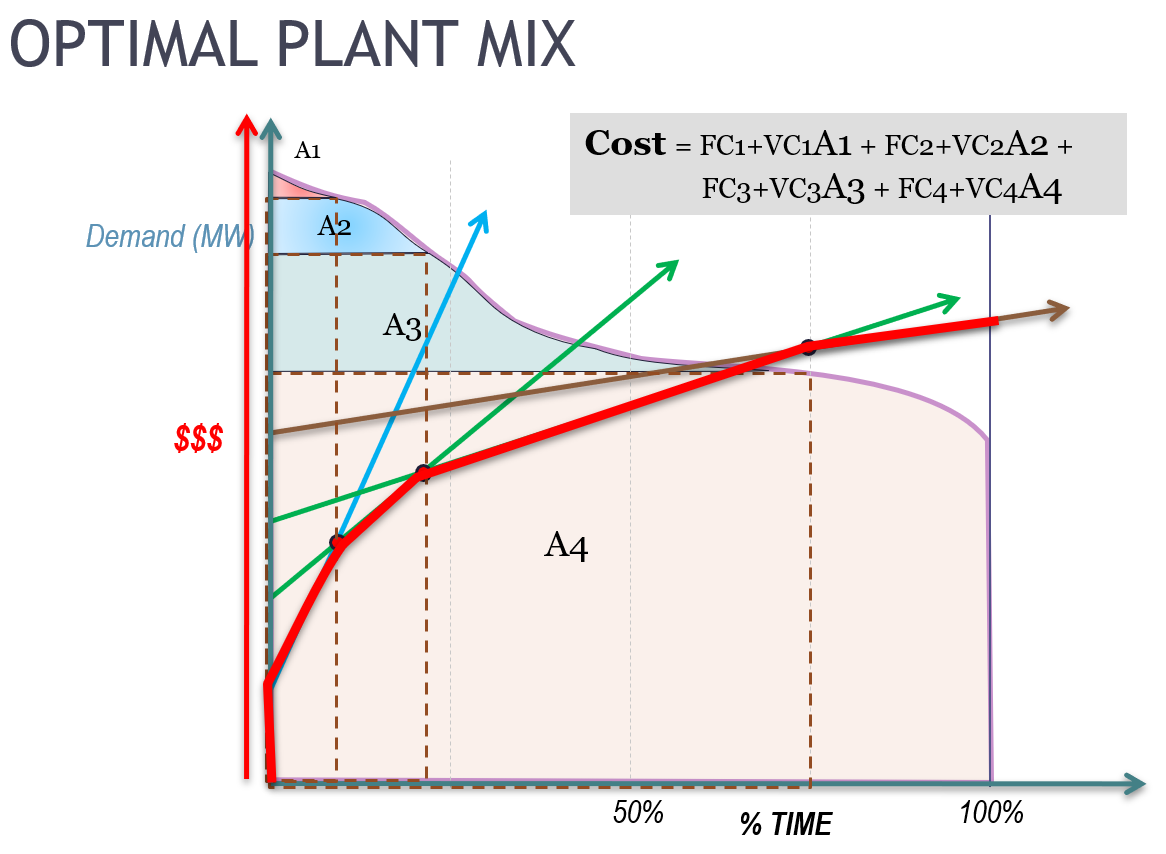
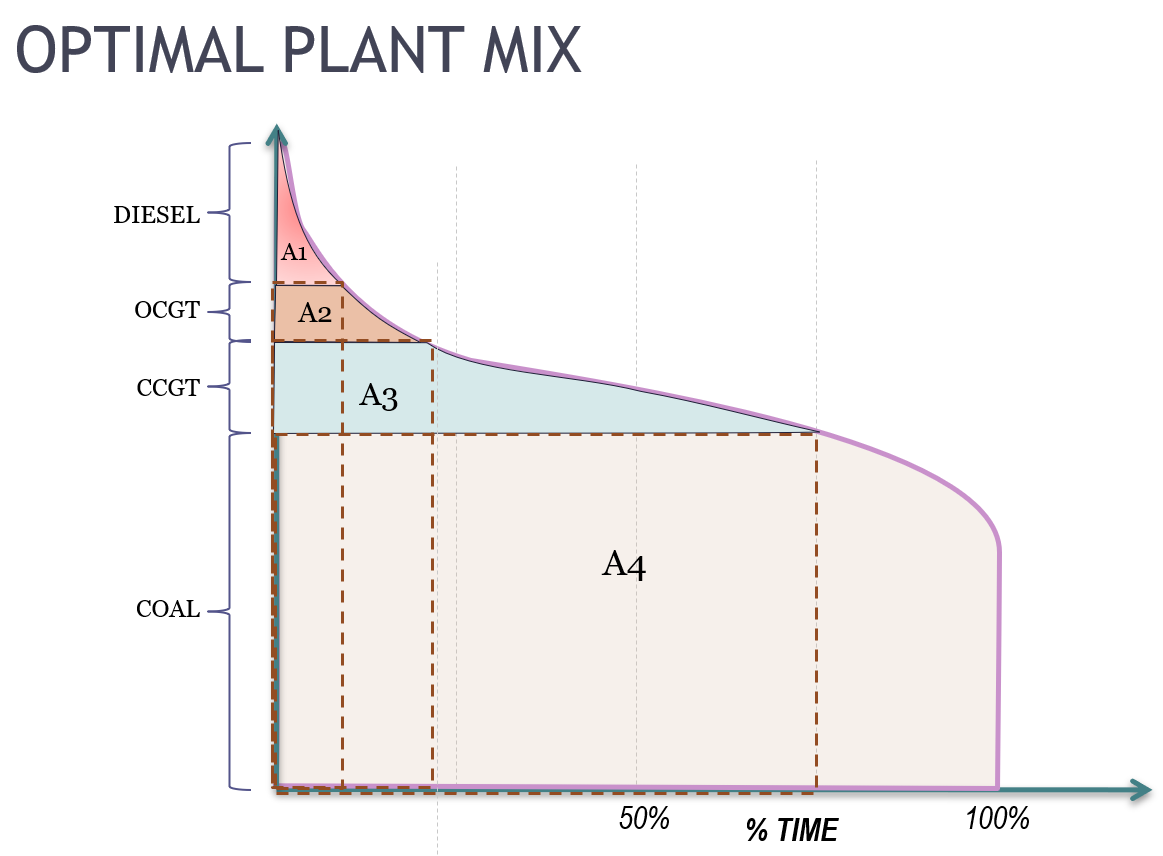
To supply the energy defined by the Load Duration Curve (LDC) efficiently, an Optimal Plant Mix is generated. This is traditionally evaluated using a screening curve, where generators are selected based on an objective function that minimizes total costs (fixed + variable) using a linear programming system.
The Theoretical "Ideal"
In a perfectly planned or regulated environment, the mix is categorized by the economic trade-off between capital investment and running costs:
- Baseload Stations (e.g., Coal, Nuclear): These plants are very expensive to build but have a very small incremental operating cost. Therefore, they are best suited to supply the vast majority of the base energy requirements.
- Intermediate Stations (e.g., CCGT):: A middle ground that ramps up and down as demand fluctuates throughout the day.
- Peaking Stations (e.g., Diesel/Oil, Open Cycle Gas): These units are cheaper to install but very expensive to operate due to high fuel costs. Because of this cost structure, they are only economically viable to operate for a small fraction of time (e.g., 3%) to cover extreme peak periods.
Modern Market Dynamics
While the Optimal Plant Mix serves as a "North Star" for long-term planning, it is important to note that this model is largely theoretical. In today’s deregulated markets, the actual dispatch of plants is significantly more complex:
The Market Filter: Generation planners aim for this optimal mix, but they essentially rely on market forces to discourage expensive plants from operating. Unlike a centralized utility "ordering" a plant to run, the market dictates dispatch based on competitive bidding.
- Path Dependency: The "ideal" mix is often constrained by existing generation capacity. Utilities cannot simply swap out a coal plant for a gas plant overnight; they must manage the transition of legacy assets.
- Market Volatility: The rise of merchant power plants and intermittent renewables makes the market more unpredictable. A plant that is theoretically "optimal" on paper may struggle to be profitable if market prices are suppressed by subsidized renewables or volatile fuel costs.
- Grid Stability vs. Economics: While the screening curve focuses on cost, the real-world market must also account for ancillary services, ramping capabilities, and local constraints that the basic LDC model often ignores.
In summary, the Optimal Plant Mix represents the most efficient state of the system, but the actual operation is a moving target influenced by market design, policy shifts, and the existing physical fleet.